Organic Mattresses & Materials
How to Evaluate Organic Bed Construction: Certifications, Layers, and Care
“Organic” can be a helpful starting point when comparing beds, but it is not a complete description of how a mattress feels, how it is made, or how to look after it. A closer look at certifications, individual layers, and care requirements can turn a broad label into a more useful picture of what you are considering.
Published November 2, 2026
Start by looking beyond the word “organic”
A mattress is a construction, not a single material. Its core, comfort layers, flame barrier, and outer cover can all be made from different materials, and each part contributes something different to the finished bed. A latex core may provide resilient support, for example, while wool can add cushioning or serve as a flame barrier. Cotton is often used for a cover or casing. The word “organic” does not tell you whether those layers are arranged in a way that suits your comfort preferences—or whether every component has the same certification status.
A useful evaluation therefore has three parts: verify what a certification applies to, understand the job of each layer, and check what everyday care and support the mattress requires. That approach makes it easier to compare natural latex mattresses without relying on soft-focus language such as “pure,” “clean,” or “all natural,” which may not explain the actual construction.
Think of your research as reading a recipe. The ingredients matter, but so do their proportions, the way they are combined, and what the finished result asks of you. Clear specifications help you make those connections before a mattress becomes part of your bedroom.
What mattress certifications can—and cannot—tell you
Certifications are most useful when you know their scope. A certification may relate to a particular material, a finished product, or the way a textile is processed. It should not automatically be read as proof that every part of a mattress is organic, chemical-free, or produced under identical conditions. Look for the certifier’s name, the certified product or material, and a current certificate or other documentation that lets you verify the claim.
For latex, the Global Organic Latex Standard (GOLS) is one certification consumers may encounter. It concerns organic latex and sets requirements for the relevant material and supply chain. A GOLS claim about a latex core does not, by itself, certify a mattress cover made from another material. Check whether the maker identifies the latex as certified and whether the scope of the certificate corresponds to the specific component being discussed.
For textiles, the Global Organic Textile Standard (GOTS) is a standard for organic fibers and textile processing. It can be relevant to cotton used in a cover or other textile component. As with latex, ask what exactly is certified: the fabric, a finished textile product, or something else in the supply chain. A mattress can contain a certified organic cotton cover while other parts have different materials or certifications.
Other labels can answer different questions. OEKO-TEX® STANDARD 100, for instance, is a product-testing label associated with testing for certain harmful substances. It is not the same as an organic certification. A label stating that a material is tested, natural, or low in a particular substance should not be treated as interchangeable with proof of organic production.
A calm, specific claim is generally more informative than a sweeping one. If a product page says “certified organic,” look for the standard, the relevant material, and an explanation of what the certification covers. If those details are not available, contact the manufacturer. Asking for clarification is not nitpicking; it is how a broad marketing phrase becomes a checkable statement.
A simple certification checklist
Before comparing prices or comfort descriptions, collect the basic facts in one place. A short checklist can reveal whether two mattresses that both use the word “organic” are actually making similar claims.
- Name the standard. Is the claim tied to GOLS, GOTS, or another specific program?
- Identify the component. Does it cover the latex, cotton cover, wool, or finished product?
- Check the wording. Is the material described as certified, or merely as natural or organic-inspired?
- Look for documentation. Can the manufacturer provide certificate information or explain how to verify it?
- Separate different claims. Organic certification, chemical testing, country of origin, and manufacturing location are distinct details.
This checklist does not rank one mattress as universally better than another. It helps you understand what the available evidence supports. Certification is one piece of the decision, alongside comfort, durability, construction, maintenance, and the practical fit of the bed in your home.
Read the mattress from the inside out
Product descriptions often lead with the cover or an inviting surface feel. For an informed comparison, work from the central support structure outward. Ask what carries the body, what changes the surface feel, what separates or wraps the layers, and what protects the assembly. The answer may be a single material in several forms or a combination of latex, wool, cotton, and other components.
The core: the bed’s main support structure
In a latex mattress, the latex core is usually the central support element. Latex has a responsive, buoyant feel for many sleepers: it compresses under pressure and tends to recover its shape rather than feeling like a slow-sinking material. That response varies with the latex type, firmness, thickness, and the layers around it. “Natural latex” alone does not tell you how soft or supportive the finished bed will feel.
Ask whether the latex is Dunlop, Talalay, or a combination, and whether firmness can be selected or changed. Also find out how thick each latex layer is and whether a mattress is one solid unit or built from separate layers. A layered design can allow different firmness choices, but it may involve assembly at home and some ongoing attention to the manufacturer’s instructions.
Comfort layers: where feel and pressure relief take shape
Comfort layers sit above the core and influence the first impression when you lie down. A soft latex layer may create more cushioning; a firmer layer may feel more supportive. The number and thickness of these layers matter, as does how they interact. A thick plush top can change the feel of a firm support core, while a thinner surface layer may preserve a more direct, responsive sensation.
A manufacturer’s firmness labels are not a universal scale. If possible, test the mattress in your usual sleeping position, and consider whether your preference is for a gentle surface cushion or a more level, buoyant feel. For shared beds, ask whether the layers can be configured differently on each side. That option can be valuable for couples whose comfort preferences do not match.
Wool: a layer with several possible roles
Wool may appear as upholstery, a cushioning layer, or a flame barrier, depending on the design. Its natural crimp gives it a springy texture, and wool can help manage moisture and temperature in bedding. But the presence of wool does not describe how thick the layer is, how it is processed, or how much it changes the feel of the mattress. Those details are worth confirming.
If the wool is described as organic or responsibly sourced, ask which claim is being made and whether it is supported by a named standard or sourcing information. Wool used in a mattress should also be distinguished from a removable wool mattress pad. A pad is an accessory placed on the surface; it does not tell you what is inside the mattress.
Cotton and the outer cover
Cotton is commonly used in mattress covers, casings, or quilting. The cover affects the surface feel, protects the internal materials, and can determine whether a bed can be opened for layer changes. Check whether the cotton is organic-certified, whether it is quilted with another fiber, and whether the cover is removable. Removable does not necessarily mean machine washable: many mattress covers are intended for spot cleaning only.
Construction details such as seams, quilting, closures, and handles can also matter in everyday use. A zippered cover may make the layers accessible, but it is not an invitation to wash the whole cover unless care instructions explicitly say so. Confirm the mattress’s total height, particularly if you already own deep-pocket sheets or plan to add a topper or protector.
Use a layer-by-layer comparison
When two product descriptions are filled with unfamiliar terms, a small comparison table can help. Write down the components rather than relying on an overall label. The exercise can be as simple as noting the core, comfort layers, cover, certifications, and care instructions for each option.
| Part of the bed | What to find out | Why it matters |
|---|---|---|
| Core | Material, thickness, firmness choices, and construction | Helps explain the main support and overall response |
| Comfort layers | Material, number of layers, and whether they can be adjusted | Influences surface cushioning and pressure feel |
| Wool or other barrier | Purpose, sourcing, and any stated certification | Clarifies its role instead of treating it as a general quality claim |
| Cover | Fiber content, certification, closure, and cleaning method | Affects surface contact, protection, and maintenance |
| Foundation and care | Support requirements, ventilation, rotation, and warranty terms | Helps the mattress work as intended over time |
The table also makes gaps visible. If a listing describes a “natural latex mattress” but provides no details about layer thickness, cover fiber, support requirements, or cleaning, you know what to ask before deciding. Specificity is useful even when the answer is that a detail is unavailable.
What modular construction can offer
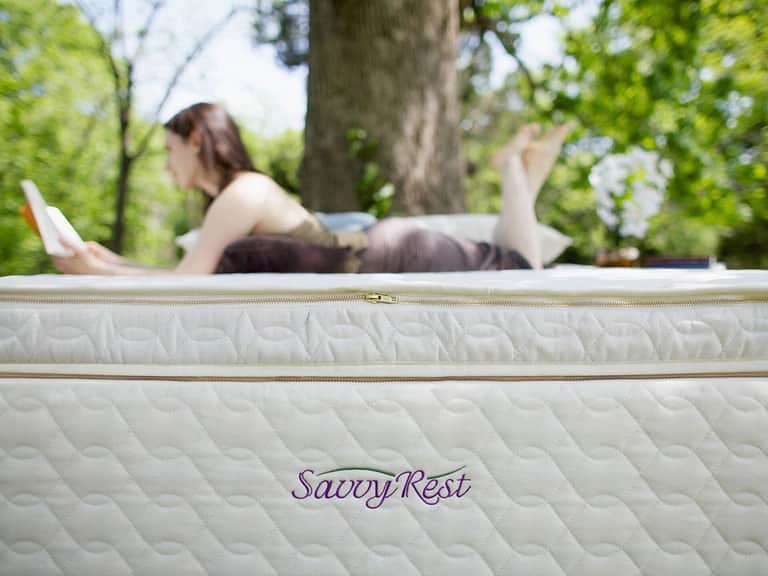
Some latex beds use individual layers inside a zippered organic cotton casing. In certain designs, the layers can be chosen for different firmness levels or exchanged during an adjustment period. This construction can give sleepers more control over the feel of the mattress, though customization is only helpful if the available choices are clearly explained and the process suits your needs.
The Savvy Rest Unity Pillowtop Latex Mattress is one example of a layered design. Its product information describes a 13-inch mattress combining a three-layer Serenity mattress with a separate latex topper, with layer firmness choices and side customization available in queen and king sizes. The listed materials include certified organic Dunlop latex, certified organic cotton in the outer casing, and certified wool used as a flame barrier. The product description also notes a 90-day layer exchange policy, a limited 20-year warranty, and a requirement for an appropriate rigid or slatted support surface if it is not placed on a compatible foundation.
Those details are useful because they connect material claims with how the bed is assembled and maintained. They should still be assessed on their own terms: confirm current certification documentation and exchange conditions with the maker, and make sure the mattress height, firmness options, base requirements, and care instructions fit your situation. A layered mattress is not automatically the right choice for every sleeper simply because it offers customization.
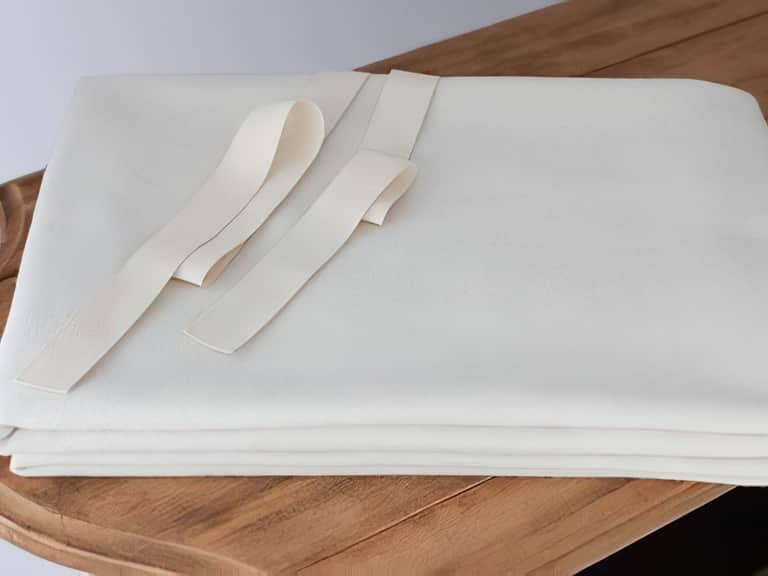
A separate wool pad is another way to add a material layer without changing the mattress’s internal construction. For example, the Savvy Rest Wool Mattress Pad is described as a removable surface accessory made with wool and cotton straps, rather than as a wool layer built into a mattress. Its care instructions call for hand washing in mild detergent and line drying. Keeping that distinction clear helps prevent confusion between mattress composition and add-on bedding.
Care begins with the foundation
A carefully made mattress still needs suitable support. Read the manufacturer’s foundation requirements before installation: some designs call for a rigid platform, while others specify slats with particular spacing. A support surface that does not meet those requirements may affect the feel of the mattress and could complicate a warranty claim. If you use an adjustable base, confirm compatibility for the exact model rather than assuming every latex bed can bend safely.
Ventilation is another practical consideration. Follow the maker’s instructions about slatted bases, airflow, and placing the mattress directly on a platform. Keep the sleeping space reasonably dry and avoid trapping moisture between the mattress and its support. Good ventilation is not a substitute for following the product’s care directions, but it is an important part of maintaining bedding in everyday use.
A washable protector can shield the cover from spills, sweat, and everyday soils. Choose one that fits securely and does not change the feel or temperature of the bed more than you want. A protector is different from a pad: some prioritize a barrier, while others add softness. Check each item’s fiber content and cleaning instructions, and avoid assuming that a naturally derived textile can be washed in the same way as ordinary sheets.
Cleaning a mattress itself should be conservative. Many covers are not machine washable, even when they zip off. Spot-clean only as directed, use the approved method, and let the area dry completely before remaking the bed. Do not apply bleach, solvents, or heat unless the manufacturer specifically permits them. When care instructions are unclear, ask before experimenting.
Rotation, flipping, and warranty details
Rotation and flipping are not interchangeable instructions. A one-sided mattress may be designed to sleep on only one surface; flipping it can put its layers in the wrong order. Another design may be reversible, while a modular mattress may need its layers arranged according to a particular plan. Follow the specific guidance for the model, including how often it should be turned or whether it should be left in place.
Before purchase, read the warranty alongside the care sheet. Note the length of the warranty, what it covers, what it excludes, and what evidence may be needed if a problem arises. Ask whether an approved foundation is required, whether stains affect coverage, and whether changing layers has any conditions. A long warranty is not a prediction of how long every mattress will feel unchanged; it is a document defining particular terms.
Keep the product specifications and care instructions somewhere you can find them. Record the model, purchase date, and any setup steps that may be relevant. These are small habits, but they make maintenance less of a mystery and help you check the manufacturer’s current guidance when questions come up.
Questions worth asking before you choose
A good product conversation should leave you with clear answers rather than more adjectives. Consider asking:
- Which materials make up the core, comfort layers, flame barrier, and cover?
- Which exact components are certified, and under which standards?
- Can certification details be verified for this specific model?
- What do the firmness options mean, and can layers be changed after delivery?
- What kind of foundation is required, and is the mattress compatible with an adjustable base?
- Can the cover be removed, and what cleaning method is permitted?
- Should the mattress be rotated, flipped, or left in its original orientation?
- What are the exchange, return, and warranty terms, including any setup requirements?
If the response distinguishes clearly between certified materials, comfort options, and care requirements, you can compare the bed with confidence. If a claim remains vague, treat it as an open question rather than filling in the missing detail yourself.
The bottom line: evaluate the whole construction
An organic bed is best understood as a set of components with separate jobs. Certifications can help substantiate claims about latex or cotton, but they need to be read in context. The core and comfort layers shape support and feel; wool may serve as upholstery or a flame barrier; and cotton often forms the cover or casing. Care instructions, ventilation, foundation compatibility, and warranty terms complete the picture.
The most useful comparison is not simply “organic versus not organic.” It is a careful look at what the mattress contains, what evidence supports its material claims, and how those materials work together in a design you can maintain. A product description that answers those questions gives you more to work with than a luxurious-sounding label alone.
Take your time, ask for specifics, and let your own comfort preferences guide the final choice. Organic certifications can help you make an informed decision, but a mattress still has to suit the sleeper, the bedroom setup, and the routines that keep it in good condition.